Table of Contents
Why Product Recommendations Work Differently for Subscriptions
Most product recommendation advice was written for one-time ecommerce, where the goal is squeezing an extra item into a cart before the customer disappears forever. Subscriptions play a different game. Your customer isn't disappearing. They're coming back next month, and the month after that, whether or not you upsell them today.
That changes the math completely. A one-time store celebrates an $8 upsell as $8. A subscription brand should see it as $8 per order, every order. A subscriber who adds $8 of product to a monthly subscription is worth $96 more per year, and the recommendation that got them there took thirty seconds to configure.
It also changes the strategy. Timing beats placement, recurring attachment beats one-time conversion, and the Customer Portal beats checkout as your upsell surface. This post covers all three, with the numbers to back it up. For the full menu of AOV tactics beyond upsells, the subscription AOV playbook covers upgrade and save strategies end to end.
The $6-$10 AOV Lift: What Subscription Brands Actually See
Skio merchants running Smart Upsell typically see AOV lifts in the $6 to $10 per order range across categories like CPG, pet, grooming, and oral care. Waterboy, a hydration brand running Smart Upsell with one-time add-ons, 4X'd their add-on revenue and doubled overall growth.
Why does that range matter? Because $6 to $10 per order is the difference between eating shipping costs and covering them. It's margin improvement that requires no new customers, no ad spend, and no discounting. And unlike a one-time bump, it compounds. Get a subscriber attached to an add-on product and the lift shows up on every renewal.
The attachment math is what makes this a Champion-level priority rather than a nice-to-have. Even a modest share of your base adding one product moves annual revenue in a way most acquisition campaigns can't match on cost.
Where Generic Recommendation Strategies Fail for Subscriptions
The big recommendation engines were built for a different problem:
They optimize for one-time conversion. Adobe Commerce, WooCommerce plugins, and Shopify's native recommendations all chase the immediate add-to-cart. None of them think about whether the product stays attached next month
They push checkout upsells. For subscriptions, checkout is the worst possible moment. The customer is trying to commit to a recurring relationship. Piling on more products creates hesitation exactly when you want momentum
Collaborative filtering ignores subscription context. "Customers who bought this also bought" doesn't know the customer's delivery frequency, what's already in their box, or whether the recommendation even makes sense on a recurring cadence
They can't reach the portal. Generic engines have no access to the Customer Portal, which is where subscribers actually spend their management time and where upsells convert best
The gap isn't intelligence. It's context. Subscription upsells need subscription data.
The 3 Subscription Upsell Strategies That Actually Work
Post-purchase timing. Show recommendations after the subscriber has committed, in email, SMS, and the Customer Portal. The subscriber browsing their portal is in management mode, relaxed and receptive. The subscriber at checkout is in commitment mode, and every added decision risks the whole order.
Behavior-based targeting. Recommend based on what this subscriber already receives, not what other customers bought. A coffee subscriber should see filters and mugs. A dog food subscriber should see treats for their dog's size. Relevance is the whole game.
One-time add-ons before recurring commitments. Let subscribers test a product on their next order without signing up for it forever. Low commitment converts. Then let repeat behavior earn the recurring slot.
Smart Upsell executes all three inside Skio, surfacing personalized product carousels in the Customer Portal based on current subscription contents, with deep-link upsells available for email and SMS campaigns.
How Smart Upsell Works
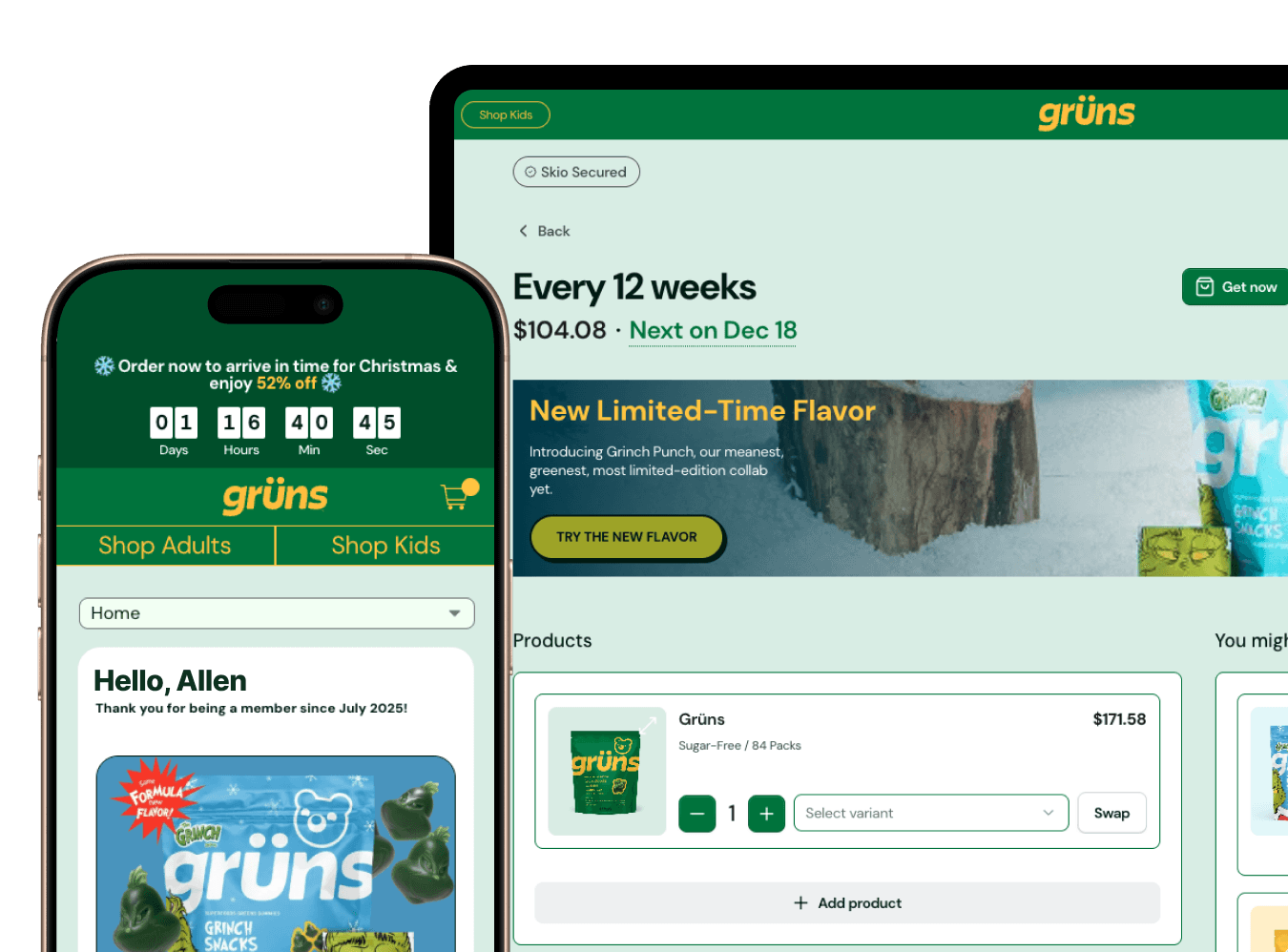
Smart Upsell reads what's in each subscription and surfaces complementary products in the Customer Portal. The subscriber with a monthly coffee box sees flavor add-ons and brewing gear. The subscriber with a protein subscription sees the shaker and the sample of the new flavor. Nobody sees products they already receive.
The carousel is actionable, not decorative. Subscribers add products to their next order in one click, either as a one-time addition or a recurring line. And through the Klaviyo integration, the same subscription data can trigger personalized upsell campaigns by email, so the portal isn't your only surface.
One-Time Add-Ons: The Low-Friction Path to Higher AOV
Here's the conversion psychology that most brands get backwards. Asking a subscriber to add $12/month to their subscription is a big ask. Asking them to try a $12 product on their next order is a small one. Same product, wildly different conversion.
One-time upsells in Skio let subscribers add products to a single upcoming order without touching their recurring lineup. The path that follows is predictable and lovely. One-time add-on, then a repeat add-on, then "just make it recurring." The subscriber talks themselves into the recurring commitment through their own behavior, which converts far better than you asking upfront.
This was the core of Waterboy's playbook. One-time add-ons in the portal reduced commitment friction, add-on revenue quadrupled, and growth followed.
Upsell Timing: Post-Purchase Beats Checkout
Checkout upsells | Post-purchase upsells | |
|---|---|---|
Subscriber mindset | Commitment mode, trying to finish | Management mode, browsing |
Friction added | High, risks the core order | None, order already secured |
Typical conversion | Low single digits | Several times higher |
Product stickiness | Often removed later | Higher long-term attachment |
The pattern across Skio merchants is consistent. Post-purchase upsells convert several times better than checkout upsells. Not because the products differ, but because the moment does. A subscriber managing their subscription has time and attention. A subscriber checking out has a finger hovering over the buy button and no patience for detours.
Cross-Sell Mechanics: Choosing What to Recommend
Complementary, never competitive. Recommend products that enhance the core subscription. Never products that could replace it
Watch the price point. Add-ons priced around 30 to 50% of the core subscription convert without sticker shock. A $60 add-on to a $40 subscription reads as a second purchase decision, not an add-on
Align frequency. Don't recommend a 30-day supply to someone on a 60-day cycle. The mismatch creates surplus, and surplus creates cancellations
Use category logic. Pet food subscribers get treats and supplements, not more pet food. Skincare subscribers get the complementary step in the routine, not a competing moisturizer
Cap the carousel. Three to five products. A wall of options is a decision nobody makes
Measuring Upsell Performance
Track four numbers, in this order of importance:
Incremental AOV. The average order value lift from upsells. This is the headline metric
Attachment rate. The share of subscribers with at least one upsell product. Low attachment with a live carousel means your targeting is off
Retention of upsold products. If subscribers remove the add-on after one or two orders, the recommendation was clever but wrong
Conversion by channel. Portal versus email versus SMS. Double down where your base actually converts
All of it lives in Skio's Products Dashboard. Measure the LTV impact over twelve months, not the first-order pop. That's where subscription upsells earn their keep.
Common Upsell Mistakes That Kill AOV Growth
Showing upsells at checkout because that's what one-time ecommerce taught you
Making every upsell recurring by default, which forces commitment and tanks conversion
Recommending against the subscriber's frequency, creating product pileup
Skipping the one-time add-on test phase and wondering why recurring upsells won't move
Cramming ten products into the carousel
Ignoring mobile, where most subscribers actually manage their subscriptions
None of these are exotic. They're all defaults inherited from one-time ecommerce playbooks. Subscription upsells need subscription defaults.
Setting Up Smart Upsells in Skio
Enable Smart Upsell in the Skio dashboard under Grow > Smart Upsell
Select the products to recommend and set targeting based on current subscription contents
Configure one-time versus recurring options per product. Start one-time
Customize how the carousel appears in the Customer Portal
Connect Klaviyo or Attentive to extend upsells into email and SMS
Watch the Products Dashboard for attachment rate and incremental AOV
The whole setup is an afternoon. Start with three to five complementary products as one-time add-ons, let the data tell you which ones deserve recurring status, and expand from there.
How Waterboy 4X'd Add-On Revenue
Waterboy sells hydration powder subscriptions. Lower AOV category, real churn risk, the kind of business where every dollar of order value matters.
Their move was Smart Upsell with one-time add-ons in the Customer Portal. Subscribers managing their hydration subscription saw complementary products they could add to their next order with one click and zero recurring commitment. The friction disappeared, the willingness to experiment went up, and add-on revenue quadrupled while overall growth doubled.
The lesson isn't "turn on upsells." It's that the portal, post-purchase, with one-time options, is where subscription upsells actually convert. Waterboy didn't interrupt the subscriber experience. They enhanced it, and got paid for it every month since.
FAQ
What's the average AOV lift from subscription upsells?
Skio merchants typically see $6 to $10 per order from well-timed post-purchase upsells. Because it recurs, an $8 lift is worth roughly $96 per subscriber per year.
Should upsells be one-time or recurring?
Start one-time. Subscribers convert far better on low-commitment offers, and repeat one-time behavior tells you exactly which products deserve a recurring slot.
Where should I show product recommendations to subscribers?
The Customer Portal first. Subscribers there are in management mode and convert several times better than at checkout. Extend to email and SMS once the portal carousel is working.
How do I choose which products to recommend?
Complementary products priced around 30 to 50% of the core subscription, aligned to the subscriber's delivery frequency, never duplicating what they already receive.
What's a good attachment rate for upsells?
Enough of your base should attach that incremental AOV moves visibly in the Products Dashboard. More important than the raw rate is retention. Subscribers should keep the add-on past the first order or two.
Can I use Shopify's native product recommendations for subscriptions?
They optimize for one-time conversion, can't reach the Customer Portal, and don't distinguish subscription context. For recurring revenue you need subscription-native recommendations.